Showing posts with label Western Riding. Show all posts

Thursday, August 6, 2015

Tracy Meisenbach-Stark Naked Bit™, how it works, and what you need to know

                                                        The Stark Naked Bit™:
           Jaw bits have existed since humans first decided to ride on the backs of horses. They are one of the earliest methods of communication between man and equine.


       Jaw bits have been made of rope, leather, braided grass cord, rawhide, twine and now Biothane ®. The action of a jaw bit is direct, but also muted. There is no leverage like a curb, no dragging across the tongue like a snaffle. It's direct and too the point, which is how all communication should be.

         We're going to look at a few different jaw bits. The leather jaw bit, with and without side rings, has existed since the 1800s. Prints of them can be found in The Horse by William Yount (1843), The Modern Art of Training Wild Horses by William Rarey (1858) and several catalogs including the 1886 Langrun's. 

       Metal jaw bits were actually created and used for awhile, but the dynamics were harsh and unstable. 

     This is the Donnelly Bridleless Bit. The flat metal mouth would dig in when the reins were pulled. Used without a headstall and the flat slightly inverted band will dig into the tongue. Not a very nice bit for the horse.

      Leather bits seem to fall into two categories. Round braided leather with a jaw knot, or flat stitched leather, made as a multi-layer strap with rein rings.  Leather jaw bits were used by the Native Americans, and even in some Asian tribes. Most worked with a jaw knot and would tighten if pulled on. The horse rarely had a choice where his tongue went, the bit was placed over it or under it at the whim of the rider. They could be ridden single or double reined, one handed or two. 
         One of the leather versions is a round rolled Snake Bit. It tightens as the reins are pulled and does require the use of a headstall. I'm not a big fan of it.

         In more modern times Erwin Meroth patented a version of the leather jaw bit and its tanning process in 1985, in Germany. It was never patented in the United States. Meroth passed away in 2000 and his patent was never renewed after the 20 year time limit was up in 2005. His website can be found here: Merothische. If you are looking for an original Meroth Bit we suggest buying from the actual maker, not a distributor, to make sure you get the original product.
         The Meroth bit site states that the leather is vegetable tanned and safe for use as a bit. That it meets European ratings for use in children's toys. Which is very good. However, we visited the website of the tanner that creates the leather used in the Meroth bit and we were surprised at what we found.

        Krekelberg Tannery
        
        On the Krekelberg site it explains their tanning process and I have to say I was rather startled. And I mean REALLY startled. When you go to their processing page it tells you how they do it:

        It's first tanned with lime, which is a corrosive base when combined with water. This is the translation: Dehairing and liming: means sodium sulfide and lime frees the skin of the hair. The case produced heavily loaded with nitrogen-containing organic load wastewater is in the on-site biological treatment plant cleaned.

        So basically they are treating the leather with two major corrosive solutions to dehair and soften the leather. Sodium sulfide and lime are NOT approved for oral use. And wastewater is just that, wastewater. No telling what is in there.

        So the tanning process is vegetable based, but the dehairing and liming is NOT. And in fact when you get sodium sulfide wet it turns into hydrogen sulfide, which is the chemical compound with the formula H2S. It is a colorless gas with the characteristic foul odor of rotten eggs; it is heavier than air, very poisonous, corrosive, flammable, and explosive.
Like sodium hydroxide, also known as lye and caustic soda with a highly caustic metallic base and alkali salt , sodium sulfide is strongly alkaline and can cause skin burns. Acids react with it to rapidly produce hydrogen sulfide, which is highly toxic.

        Sorry, but that does not seem safe. Certainly not more safe than Biothane® which is not made with those compounds. And vegetable tanning, which is pretty much drum soaking, is not going to remove caustic compounds from the leather. This is probably why the bondage industry has moved away from the use of leather in the creation of their products. 
        This is what a used Meroth looks like after just a few uses Meroth Used Bit

        Looking at jaw bit options had us scratching our heads. We liked the concept but not the potential problems. There is a cleanliness issue. Stretching is a problem, drying out and cracking, the small thin "safety" strings breaking in mid ride and several other issues. I don't WANT a bit that conforms to the mouth and just grips the tongue and jaw tightly. That method provides no relief or reward. So we looked around and found a product called Biothane ®. And therein was our solution. Biothane® can be sterilized, leather cannot. You can dunk a Biothane® bit in listerine, novalsan, alcohol or whatever other method and not change the composition of the bit. Do that with leather and you'll mess it up and remove the protective oils.

        We contacted an Amish Harness Maker and had several discussions with him about the material, stitching ring sizes and knew right away that since horses were not "one size fits all" we decided our bits wouldn't be either. We created several widths; 1/2 inch, 3/4 inch and 1 inch so that a rider could determine the sharpness of the action. The narrower is sharper and the wider is milder. We also decided on two different ring sizes. The 2 inch ring has more weight and vibration, with more pre-signal while the 1.5 inch ring is quieter and more direct. And so the Stark Naked Bit™ was born.

        One thing we really wanted to fix was the bit molding into one horse's mouth's shape and never springing back into shape. We knew that Biothane ® had a shape "memory" but we were really excited to find that the method of stitching created a bit that would spring back into shape and remove pressure from the lips and edges of the mouth. You pull back and release and the horse is rewarded with a reduction of pressure.


In the end we're pretty happy with our product and so are our customers. The bits are Biothane ® so they last longer and can be cleaned easier. They are stitched in such a way that they spring back into shape and take pressure off the sides of the mouth. They don't put any more pressure on the tongue than a metal bit and the horse can eat and drink with one in his mouth. They can be used with or without a headstall. People have been using them for jumping, barrels, trail riding etc. We are using one to start a green horse and will be documenting it with video.They come in a rainbow of colors and we can even make them two-toned!


You can visit us on facebook at Stark Naked Bits or our website at Stark Naked Bits.com

Either way, Get Serious, Ride Naked!


Thursday, June 25, 2015

Tracy Meisenbach- A Good Bit of Knowledge

A good bit of knowledge and knowledge of a good bit are both needed to become an excellent horseman.


We talk about a lot of bad bits, because, well because there is so MUCH material to work with. There is just a never ending line of bad bits being created all the time to solve every problem that doesn't exist until someone's butt hits the saddle.
Some of these bits are just touted as being down right miraculous and able to do things a horse can't physically. Most of us can see at a glance when a bit is horrible. But what makes a good bit? Where do we look first and what do we look for?


A) Look at the mouthpiece. Doesn't matter what you intend for the bit to do, where it comes in contact with the horse's soft membranes needs to be the absolute priority. The tongue and lips are very sensitive. You're talking about something that can pick up a single oat and can feel the slightest touch. Doubt me? Try to poke your finger into the lips and run it along the bar edge. Most horses will immediately raise their head, even if you aren't pressing down. Look at the anatomy of the horse's mouth. It's all soft curves (tongue and palate) and hard edges (bars and teeth) Anything you use is going to pull, vibrate, rub, drag or poke all of these things at some point. A horse will tolerate a lot if whatever is moving in his mouth is SMOOTH. Smooth and able to glide across the tongue and lips. Saliva can lubricate, but if there are ridges, twists or gaps in the bit guess where the saliva goes? Yep, so then the bit rides down on the tongue and lips. Start smooth, stay smooth. No green horse should ever be in anything but a smooth mouthpiece bits. You are starting his lifelong perception of being handled and compelling obedience with a sharp mouth is not a good way to build trust.


1) Thin closed twist, very sharp, can cut the tongue, lip and bars.

2) Open twist, square stock. Square stock is different from regular round twisted wire as it retains the edges of the square. These sharp edges can cut and dig into the tongue. See saw action can literally saw into the tissue.
3) Wide twist thin square stock. All those thin sharp edges move back and forth across the tongue and lips.
4) Open twist round wire, abrasive, grooves are wide enough to grab the pebbled surface of the tongue, also the edges of the lip. Any action on the tissue of the bars will be abrasive.
5) Wide twist thick square stock. This is a slow twist bit that people seem to think is kinder than a regular twisted wire. It's not. This big sharp edges create pressure points as they move across the tongue.
6) Waterford. Pretty much goes standing link, flat link, ball, flat link, standing link, ball, standing link, flat link, ball, flat link etc. Every one of those balls is a pressure point on the tongue. Yes the bit does form to the horse's mouth, yes the edges are rounded, however this mouth also creates pinch points between each standing and flat link. When it moves side to side it will grab the edges of the tongue and the lips.
7) Big link flat chain, Mikmar. This bit has GRAB. The flat joint in the middle allows the tongue to get caught and the wide spaces in the links also let in tongue tissue. The side joints at the lips are narrow and when the bit moves side to side they grab the lips and pull them out with the bit. (I own this one and know how it works)
8) Thin bike chain. Forms to the mouth, rolls over the tongue like a series of thin edged tissue grabbers. Extremely rough on the edges of the lips and over any tissue that sits over bone.
9) Open work flat chain. Most flat chain bits are fairly mild, but when they are like this with open links that don't "stack" over the next link they are abrasive and particularly nasty at the edges of the lips and over the bars.
10) Standing link wide chain. Every other link is a hard pressure point into the tongue, pulling through the lips they create spread and then allow the lip to close over the next link, until pulled back through, catching the edges as the bit moves back and forth.


B) Look at the joints and joinings. Joints should have smooth movement without pinch. Roller joints that stick below the cannons create pressure points. Any welds should be ground smooth. Connection to the shanks should be tight so no pinching occurs. Look at the length and shape of the joint. Single joints break over the tongue, the best ones are on slightly curved cannons and have nicely rounded edges. How curved? If it's a single joint you should be able to fold the bit flat. That's the right amount of curve. If you can't fold it flat the cannons are too straight. If you fold it flat and there is a huge gap between the middle of the cannons that is too much curve and it's going to work your cheeks into the jaw and around the bars hard. Double joints need to be long enough to break out over the bars, so that the tongue remains flat beneath the center joint and the ends don't ride down on the bars. Barrel joints that are smooth and fluid are acceptable, donuts and lifesavers are not. Chains are quite popular, whether linked or ball and link, but they are not all equal. None of them should be used with direct rein as they drag the lips up and out and dig hard into the tongue.


C) Mechanics. How does the bit work? Always look at the order of actions, because some of the bits marketed today do not work as advertised, especially combo bits. Anything with a shank is going to hit the mouth first. Always. Even those nasty lifter bits hit the mouth first. So your first cue is directly to the mouth, is it abrasive or communicative? Are you cuing or compelling? Pick up one rein and what happens? A lot of bits are advertised as having independent action, but is it really? Pick up one rein on a wonder bit and you move the opposite shank forward as the curbstrap tightens across the jaw. Use a high barrel joint port and you torque the bit as one side drops forward and the other remains up. So too much independent action can be bad, especially on a horse that doesn't have a good head and neck carriage. The trend is now for three piece mouthpieces and loose shanks but ask yourself what those busy mouthpieces create. To me they create temptation. It's like handing a child a stick, or a slinky. He may play with the stick, flip it around a bit, but in the end there isn't much entertainment value so he ignores it and gets bored with flipping it around. Hand him a slinky and suddenly you've got this swooshing, vibrating, entrancing thing to play with and twist around for HOURS! It's like a fidget enhancer. So start quiet, as quiet with as little movement as you can and only go up by increments. Do NOT make huge leaps in bitting. Don't go from a single joint snaffle to a correction port curb. Don't leap from mullen to waterford. It's better to go down a notch and address a problem then to leap up several levels in severity.


D) Physics. What does the bit do? When you pull what is the end result? For a direct rein 1:1 ratio bit the pressure you put on the reins becomes the pressure applied to the mouth. If your horse is running through it then you can choose to use draw reins, martingales etc to give you a momentary advantage. Or you can up the severity of the mouth, which usually only works a short time, or you can go back to ground level and re confirm your stopping cues. Your seat and leg MUST play a part in how your bit works. If you're just riding on the reins then you're numbing the horse's sensitivity to your rein cues and creating the run away. With a curb you need to assess total shank ratio. How long is the bit? Whether it has an equal purchase (1:1) or a shorter or longer one doesn't change the fact that your pressure ratio is still determine by the total shank length. What the purchase determines is how much pressure goes onto the chin and poll as well as the mouth. The sweep of the purchase also determines chin and poll pressure, as well as how hard the mouth gets hit, as the more sweep the more mouth pressure without a brake on it


E) Does your bit communicate or does it compel? If you put the bit on the horse and tug the rein does he pay attention and respond in a relaxed manner? Or does he immediately tense and either become evasive or hair trigger? If it's the second one then your bit is a problem, drop down a level and get some relaxation and communication going. Test the bit against your skin, is it smooth, balanced, has pre signal? Does it pinch, have abrupt movement, slow release? What are you saying to your horse when you pull the reins? Are you whispering or shouting?

Give you horse a chance so that even while working his bit is NOT always ON. Give him a break. He cannot stay on edge and waiting for the next painful cue and perform at his peak. Your bit has to have an off switch. This means when you loosen the reins the mouthpiece does not still cause him worry. It means his headstalls loosens a little, his curbstrap hangs loose and his tongue and lips can reseat the bit without feeling like they are being scored by sandpaper or pinched by pliers.

Look at each component and the closer they are to smooth, close joints, fluid action, good pre signal and vibration and immediate off switch the better your horse will be.


Tracy Meisenbach
Copyright 6-9-2015
Do not repost or publish without written permission

Friday, February 27, 2015

Tracy Meisenbach: Layered Leverage

Layering Leverage

There’s an old, and highly accurate saying: When you combine ignorance and leverage, you get some pretty interesting results.

Sometimes you get a horse flipping over, sometimes you get a horse panicking and bolting off and sometimes you get a really nasty fall as a horse struggles to keep upright, but can’t because his head is leveraged down.

So let's talk about layered leverage. Leverage is the basis for all bits, even snaffles. It's based on weight, gravity and resistance. With a snaffle the leverage is 1:1. You pull at one end, with your arms/body and at the other end the same amount of weight is applied to the bit. Lean your body back to augment the pull of your hand and your horse is holding up your torso weight with his mouth. Ugly to think about, but a reality.

Curb bits have leverage because of their shape. They are simple levers. Pull one end and the bit pivots around a fulcrum and places pressure on the mouth. The force is determined by the length of the shank combined with the amount of the pull. Most curbs of standard show legal length fall under a 1:4 ratio, meaning the purchase is 1/4 of the shank length. 5 pounds on the reins translates to 20 pounds in the mouth.

Gag bits are simple pulleys, whether draw gags or curb action gags. They work off of a 1:2 ratio. Whatever pressure you put on the reins is doubled in the mouth. It's the same principle as lifting a heavy object; a pulley allows us to lift double the weight. Put five pounds on the reins of the average shanked gag and when the cannons invert the purchase to shank ratio you've got 40 pounds in the mouth because the bit increases the leverage action and rachets it harder. The curbstrap doesn't stop the cannons from moving up, it just stops the purchase from rolling forward.

Draw reins are a 1:2 ratio leverage addition. Put them on a snaffle bit and they change a 5 pound pull to a 10 pound pull. Put them on a gag action curb bit and they change a 5 pound pull to an 80 pound pull. Why? Because each layer of pulley you add reduces the amount of pressure you apply and increases the amount of force at the end of where the energy is dispersed. The force has to go somewhere and in this case it's the horse's tongue.


Does your horse deserve layered leverage? No. It’s a sign of being a poor trainer without a modicum of scientific knowledge about how bits and training equipment work. It puts you at a truly unfair advantage that the horse can only equalize by freaking out. And when that happens you both lose. I have never seen a horse made better by it, but I have seen many horse ruined by the ignorant used of layered leverage.

So don't layer leverage. You're applying more force to your horse's mouth than you think.

Tracy Meisenbach
Copyright 2-2014
Do not repost or publish without written permission

Friday, January 30, 2015

Tracy Meisenbach: Shank shape and action

Shank shape and action

When people look at a curb bit most of the time the first thing to make an impression is the mouth piece, then the shank length. Now, with the influx of specialty bits and disciplines that require a horse to be more upright and slowed down into artificial movement, shanks have developed that no longer work like a standard shank.
The original concept of a curb bit was a simple lever, or pry bar style. You lifted one end up, the mouthpiece was the fulcrum, and the purchase rotated forward. The length of the lever arm determined the leverage. With the mouthpiece as the fulcrum the movement was fluid and directional toward the line of leverage. You could trace it from the top of the poll, through the purchase, mouthpiece, rein ring, up the reins to the hand. There was no loss of energy or force because it’s a direct line.

A pry bar action curb is not dictated by the shape of the shank. As long as the purchase is directly over the cannons and the lower shanks also lines up below the cannons then it doesn’t matter where the shank goes, because the mouthpiece remains the fulcrum. This is why the action of a kimberwicke, grazing bit, straight shank or cavalry shank is basically the same. Pull the rein, the bit rotates, mouth, poll and curb pressure. Of course severity is affected by the length of the shank and the type of mouthpiece, but the action remains the same.

Unfortunately newer shank styles are favoring the crowbar style of shank, which creates an entirely new action, that is higher leverage and much more severe. It’s not just a decorative shank style, it actually changes the dynamics of the bit. The lifter style of bits have crowbar action. Whether long shanked or short shanked they work the same way. With a crowbar style bit the purchase becomes the fulcrum and the mouthpiece is the dropped part of the lever. This increases force tremendously. It’s the difference between trying to pull a nail with a straight bar or with a crowbar. We all know which is better.

Lifter action occurs when the shank of the bit comes in at the cannons or above the cannons. This changes the action. A lifter bit generally has a higher purchase and the shank is curved in such a manner that it drops down into the cannons. The bit hangs down and as the reins are pulled the rotation occurs at the purchase first, then the cannons dig back and slightly up into the mouth. As pressure increases the cannons push into the tongue even harder and move higher in the mouth. It doesn’t matter how tight or loose the curb strap is, this is the action. We tested it with one finger, two fingers and three fingers between the jaw and curbstrap and even though the shank was tethered it did not decrease the action in the mouth, in fact the standard curb length of two fingers created the worst action as it allowed the bit to dig in and wad up the tongue and push it back in the mouth. If the bit has a jointed mouthpiece the pinching action is going to be extreme. The high pressure created, even with a minimal amount of pull, punishes the tongue and down onto the bars. 

On a standard curb you take the height of the purchase, divide it into the total shank length to get your purchase to shank ratio  and then you can calculate the amount of pressure the bit will create in the mouth.  The standard curb bit has a 1½" cheek and a 4½" lower shank, thus producing a 1:3 ratio of cheek to lower shank, a 1:4 ratio of cheek to full shank, thus producing 3 lbs of pressure on the chin groove and 4 lbs of pressure on the horse's mouth for every 1 lb placed on the reins. With a lifter bit you calculate differently. The measuring doesn’t stop at the purchase, it stops at the drop to the mouthpiece. So you go up the shank to the top of the purchase and back down to the drop where the cannons are. You calculate in the purchase measurement and then the entire shank to the drop becomes the total shank measurement. So a lift bit may look like a 7 inch long shank from purchase to rein ring, but when you add in the drop it becomes a 10 inch bit that has that amount of leverage. You use the same principal for measuring how much leverage a crowbar can produce, except instead of pulling up a nail, you’re driving the mouthpiece back into the tongue.

1) Kimberwicke, low port, short shank, low leverage curb
2) Grazing bit, low port, swept shank, medium leverage curb
3) Standard curb shank, high port with barrel roller, high leverage curb
4) Cavalry shank, medium port with tongue relief, long shank, high leverage curb
5) Demi-Lifter, ported chain, long shank, high leverage curb
6) Turbo Lifter, correction port, short shank, medium leverage curb
7) Paso Lifter, medium port with barrel roller, long shank, high leverage curb
8) DM Turbo Lifter, medium port, long shank, high leverage curb.


We also shot an impromptu video to show the action of the lifter bit
Turbo Lifter bit comparison

Analysis; Don't use it.

If you are interested in learning more about bits please join us on Facebook at 


Thursday, July 31, 2014

Tracy Meisenbach: A Bit Over Rated


A Bit Over Rated

Bits are the most misunderstood and misused pieces of equipment within the horse industry. People are always looking for the “magic” bit that will make their horse behave, win, go slower, go faster, look happy etc. They ignore the fact that training has to take place before a bit can do any of these things, and the training needed is usually based on everything EXCEPT the bit.
I’ve studied bits all my life, from my first horse in the 1970s to the present it’s been a lifelong journey of horses and the bits that they use. At this stage I have a pretty consistent set of go to bits; a bosal, a full cheek or a loose ring smooth mouth snaffle, a sweetwater mouth medium shank curb, a mullen or low port Pelham, and a short S shanked hackamore. Any horse coming out of my barn can be ridden in these bits and do anything you want to do that involves a horse.
During my journey I have collected bits, some through outright purchase and others came with problem horses I was rehabbing. Most of these bits hang from my tackroom wall, covered in dust, a testament to what is useless, over rated or simply inhumane. A very few I might get out, dust off and use for one particular issue, and once the issue is solved the bit goes right back on the wall. I do have a show spade bit, and I can ride in one and pass a thread/horsehair test, but there really is no need to use it, it accomplishes nothing that I can’t do with another milder bit, and my horse certainly appreciates not having to carry the weight and metal in his mouth.
When people buy a bit for the purpose of CONTROLLING the horse, they are already set up to fail. A bit isn't about control, it’s about communication. Control should be established before you ever get on the horse. Whoa means WHOA. Stand means STAND. Every other cue should be in place before your butt hits the saddle. If you can’t walk, stop, trot, stop, canter, stop, back, reverse, sidepass, turn on the forehand, pivot your horse in hand from the ground, how on earth can you expect to do it from his back? If you let your horse drag you around by the halter, why are you surprised when he drags you around by the bridle? If your horse barges into you on the ground, why are you surprised when he barges over your cues from the saddle?  At the point where you CONTROL the horse in every aspect from the ground, then you are ready to COMMUNICATE from the saddle. Control does not translate as abuse; neither does communication, although both can be used during discipline or reward.
Are you a bit junky? If you've switched bits more than a few times and nothing is working then yes, you’re a junky, because you’re looking for a solution in hand that needs to begin on your feet. If you always go up in severity instead of down, then you’re not only a junky, you’re asking for bigger problems to come along. If you routinely scour the bit sales groups, ebay and craigslist for the magical bit that is going to solve your horse’s problems then you’re a junky and in sore need of some lessons to boot. A bit does NOT train the horse. The horse is trained by communication through the seat, legs, hands and finally the bit. You train the horse's mind, not his mouth. 
So how do we know which bit is the best to use? Simpler is almost always better. We all need to learn to examine a bit forensically and actually look at each component, because in the end each component will affect the overall performance. We ALL need to understand that mild, medium and severe are factors, regardless of how the bit is used. So I'll break down a basic forensic examination:


1) Thin closed twist, very sharp, can cut the tongue, lip and bars. Severe.

2) Open twist, square stock. Square stock is different from regular round twisted wire as it retains the edges of the square. These sharp edges can cut and dig into the tongue. See saw action can literally saw into the tissue. Severe.

3) Wide twist thin square stock. All those thin sharp edges move back and forth across the tongue and lips. Severe.

4) Open twist round wire, abrasive, grooves are wide enough to grab the pebbled surface of the tongue, also the edges of the lip. Any action on the tissue of the bars will be abrasive. Severe.

5) Wide twist thick square stock. This is a slow twist bit that people seem to think is kinder than a regular twisted wire. It's not. This big sharp edges create pressure points as they move across the tongue. Severe.
6) Waterford. Pretty much goes standing link, flat link, ball, flat link, standing link, ball, standing link, flat link, ball, flat link etc. Every one of those balls is a pressure point on the tongue. Yes the bit does form to the horse's mouth, yes the edges are rounded, however this mouth also creates pinch points between each standing and flat link. When it moves side to side it will grab the edges of the tongue and the lips. Severe.
7) Big link flat chain, Mikmar. This bit has GRAB. The flat joint in the middle allows the tongue to get caught and the wide spaces in the links also let in tongue tissue. The side joints at the lips are narrow and when the bit moves side to side they grab the lips and pull them out with the bit. Severe.

8) Thin bike chain. Forms to the mouth, rolls over the tongue like a series of thin edged tissue grabbers. Extremely rough on the edges of the lips and over any tissue that sits over bone. Severe.
9) Open work flat chain. Most flat chain bits are fairly mild, but when they are like this with open links that don't "stack" over the next link they are abrasive and particularly nasty at the edges of the lips and over the bars. Severe.
10) Standing link wide chain. Every other link is a hard pressure point into the tongue, pulling through the lips they create spread and then allow the lip to close over the next link, until pulled back through, catching the edges as the bit moves back and forth. Severe.

None of these mouthpieces is soft, none is appropriate for a green horse. The right set of hands for any of these don't exist. The purpose of these mouthpieces is to create pressure points to make the horse back off the bit an intimidate him into obeying. You aren't training, you are compelling through fear. These mouthpieces are capable of causing nerve damage to the tongue, bars and lips with very little pressure. On direct pull bits the see saw action will cause a lot of abrasion, with curb action you are going to get intense pressure points with the lips being stretched and lifted by the thinner edges, the tongue being pulled back and up. Think it through carefully before you use any of these mouthpieces, because sometimes the results are physically long lasting.

Snaffles
Upper Left: Ported Full Cheek snaffle with copper rollers and flat hinge

Middle Left: French Link Full Cheek snaffle

Lower Left: Half Moon Full Cheek

Upper Right: Ported Ringmaster Snaffle

Middle Right: Regular Dee Ring Snaffle
Lower right: Regular Full Cheek Snaffle
All the bits on the left are medium, the bits on the right are mild. The Ringmaster has a floating port and will adjust to fit a horse's mouth and surprisingly most horses I've used it one really like it.


Examining a direct pull bit:
Is the mouth piece smooth or rough ( rough means wrapped, twisted, slow twist, triangular, corkscrew, chain or basically ANYTHING but round or oval). If the answer is smooth then the mouth piece is probably not severe, if the answer is rough the mouth piece is medium or severe.

Is the mouthpiece jointed, straight or ported?
Straight and smooth means no tongue relief, so it can be harsh, it also means no flexing at the corners of the mouth. Instant grab. So medium.
Mullen means curved to fit the contours of the mouth and the cannons are usually oval not round, so mild.

Straight and rough means no tongue relief, plus abrasion, instant grab. Severe.

Single jointed and smooth means the tongue can be pinched and depending on the thickness of the cannons it can be mild or quite severe. Big fat snaffles are not always better as they encourage lugging and rooting.

Double jointed bits have less pinch, but also more abrasion when the rein drags the bit across the tongue. This see-saw action occurs in EVERY direct pull bit, even a full cheek, and the lips give to the pull and the cannons move from side to side. If the mouthpiece is rough this abrasive action is going to cause pain and head tossing or over flexing.

Chain mouthpieces should never be used with a direct pull bit. Most chain is welded and the knots at the weld point are like little pressure points on the tongue as the bit drags across the mouth.

Twisted wire, slow twist, bike chain, corkscrew are all severe mouthpieces, not matter the thickness. They are abrasive and with see saw action they grab the tongue, dig back into the surface and scrape across the sensitive papillae and shred or damage them. Rough mouthpieces also damage the bars and lips of the mouth. I have rehabbed so many cut tongue horses it is disgraceful, all trained by people that thought a twisted wire mouthpiece was okay. It isn’t, ever. What these mouthpieces indicate is a lack of skill and a lack of anatomical knowledge on the part of the trainer. If a single hair on your tongue would drive you mad imagine what a mouthful of metal does to a horse.


Curb bit with horsehair loops, pull too hard and they break. If you can't ride a curb like this then you don't need to be using shanked bits. (Pixie modeling, photo by Samantha Peterson)
Please don't share to Horse Debate Central, they are too stupid to understand. 

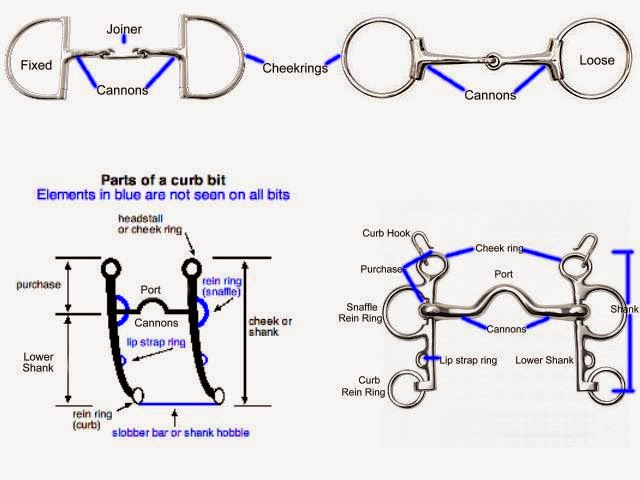
               Now on to shanked bits. Any of the above mouthpieces can be found on a shanked bit, which means that all can increase in severity rapidly. When choosing a bit for your horse understand that bits are levers. They work based on the pressure you supply creating a larger force to the bit. The curb bit consists of a mouthpiece, curb chain or strap, and a shank, with one ring on each purchase arm of the shank, and one ring on the bottom of the lever arm of the shank. Pelham bits add a ring for a snaffle rein, next to the mouthpiece. A curb bit works on several parts of a horse's head and mouth. The cannons acts on the bars, tongue and roof of the mouth. The shanks add leverage and place pressure on the poll via the crownpiece, and to the jaw via the curb chain or strap. A "loose jaw" shank, may act on the sides of the mouth and jaw. A curb bit is a leverage bit, meaning that it multiplies the pressure applied by the rider. Unlike a snaffle bit, which applies direct rein pressure from the rider's hand to the horse's mouth, the curb can amplify rein pressure several times over, depending on the length of the curb's shank. Shank sizes vary from two inches to more than 5 inches. The longer the bit shank, the more powerful its potential effect on the horse. For this reason, overall shank length, from the top of the cheek ring to the bottom of the rein ring, usually cannot exceed 8½ inches for most horse show disciplines.

                      The relation of the upper shank (purchase)—the shank length from the mouthpiece to the cheekpiece rings—and the lower shank or lever arm—the shank length from the mouthpiece to the lowest rein ring, is important in the severity of the bit. The standard curb bit has a 1½" cheek and a 4½" lower shank, thus producing a 1:3 ratio of cheek to lower shank, a 1:4 ratio of cheek to full shank, thus producing 3 lbs of pressure on the chin groove and 4 lbs of pressure on the horse's mouth for every 1 lb placed on the reins. Add in five pounds of rein pressure, the average pull needed to break a cotton thread or three strands of horsehair, and you’ve got 15 pounds on the chin and 20 pounds on the mouth BEFORE you look at mouthpiece severity or adding any training aids. Regardless of the ratio, the longer the shank, the less force is needed on the reins to provide a given amount of pressure on the mouth. So, if one were to apply 1 lb of pressure on the horse's mouth, a 2" shank would need more rein pressure than an 8" shank to provide the same effect.

            ALL bits are levers, even snaffles. There are several different kinds of levers, but all are based on the fact that at some point there is a fulcrum, and in the case of bits and bridles the mouthpiece is the fulcrum except in very special cases. In a class-1 lever, the force you apply is on the opposite side of the fulcrum to the force you produce. A curb bit is an example of a class-1 lever.
A class-2 lever is arranged a slightly different way, with the fulcrum at one end. You apply force at the other end and the force you produce is in the middle (up or out). Snaffles are an example of a class-2 lever. 


Bits can also be pulleys, even something as mild as an o-ring snaffle has a lifting effect at the corners of the mouth. If you have a gag snaffle you have a basic pulley in that pressure applied to the reins lifts the bit up the cheekpieces, applying pressure to the bit, the poll, the lips, tongue and bars. A gag action bit increases the force produced by half. So if you apply 5 pounds of rein pressure to a gag bit you get an extra 10 pounds of force in the horse's mouth added to the existent force/pressure ratio already created by the purchase/shank ratio. The more "pulleys" added to a set up means less pressure needed to produce more force. When you add in draw reins to a gag snaffle you reduce the amount of pressure needed by half, and increase the amount of force produced by another half. 5 pounds of rein pressure with draw reins/gag bit means 15 pounds of force at the fulcrum. 


Adding draw reins to a curb bit means that it requires a 1/4 of the pressure needed to achieve the same force as without the draw reins. So 5 pounds of pressure would translate to 20 pounds of force on the mouthpiece. I'm not a big fan of gimmick items, but I know that draw reins, martingales and tie downs can be used with good results IF used carefully and not as an end all solution. That being said I don't think draw reins or martingales should EVER be used with curb bits as they decrease the amount of pressure needed to provide a lot of force on the mouth. I have seen a lot of train wrecks from horses flipping over when they finally get tired of having their heads yanked in and their mouths abused. And I rarely see long term results. The moment the draw reins or martingales are taken off the horse reverts right back to getting out of frame, because the rider has not corrected the problem with their seat and legs, or the horse simply does not have the conformation to maintain the frame. 


Order of actions 1-2-3-4-5. On combo gags the noseband always engages last.

There is so much discussion about gags and combo bits, especially by the barrel racing crowd, I want to explain how they work here. People get defensive when told that the bit they are using can be harsh. All bits can be used harshly. Some bits are harsh the second they get in a horse's mouth. Regardless of the nature of the bit, each bit should have a mechanical purpose. And the fundamental of ALL horse training is that the horse moves away from pressure, not into it. So be prepared for a "scary" dissertation.

A snaffle is a direct pull bit that is supposed to draw the horse's head back, or to bend it during a turn. It supplies little to no poll pressure.

A curb bit provides leverage on the mouth, which draws the horse's chin in, and on the poll which drops the head down.

A bosal is a direct pull bit that draws the head back or into a turn, much like a snaffle, except the focus point is off the nose instead of the mouth.

A mechanical hackamore works off the nose and chin, again requiring the horse to tuck in, and some have a smidge of poll pressure, some don't.

So these bits DON'T give conflicting cues. The first action of the bit, a jiggle on the reins, is the same as the last action on the bit, a solid pull.

However, gag bits are ALWAYS about conflicting cues. 

          A snaffle gag pulls back and up, which causes poll pressure which requests the horse to lower his head. However his lips are being stretched up, so you're telling him to raise his head. Not only are you asking him to raise his head, but you're telling him that his nose going OUT is also a good idea, because HIS mechanics do not allow for his head to raise without his nose going out. During turns the bit climbs higher on the inside of the horse's face, which is a request to tilt the head OUT, while the poll pressure is requesting the head to tilt down and in.
             A gag curb is even more of a mechanical nightmare for a horse. The curb action WANTS to go in and back, but the gag action wants to go UP first, then in, then back. But the curb chain and poll pressure are telling the horse go IN and DOWN. Being told head UP and head DOWN in the same cue cycle is horrible. Gag curbs also go IN and UP with pressure on the tongue, so the tongue gets wadded up behind the cannons of the bit as the bit climbs. It is unavoidable. The cannons are dug into the tongue and the leverage is pulling the cannons UP so the tongue goes with it. There is a brilliant x-ray of a horse with a curb gag and the tongue is clearly lumped behind it.

           Now throw in a noseband. We're back to the noseband, curbstrap and poll saying DOWN and IN and the gag saying UP and OUT. What we KNOW is that the MOUTHPIECE is ALWAYS going to have the most clout with the horse. So if the gag action says UP and OUT, that's going to be his first reaction. Then the other things same no no, go down and in and now you've got a horse caught in a bear trap with no relief in sight. In most cases he fights his head, raises his neck convexly, hollows his back and does the horrible lofting with his front legs around turns and during stops. This is why most speed event horses are just bat shit crazy in the arena. It's got NOTHING to do with high spirits and everything to do with being told conflicting cues on their head.

            So bit junkies, throw away the crap, gadgets, gizmos and searches for a magical cure all bit. Train your horse from the ground to respect your cues every time and then your efforts in the saddle will be less stressful and more communicative. A bit is not going to solve your long term problems, only clear communication can do that. And cleanse your vocabulary of the phrase “It isn’t the bit, it’s the rider”. No really, sometimes it’s the bit, and most of the time the “magic” bits belong in the trash. 

Copyright July 2014
Tracy Meisenbach
Article and photos/chart cannot be used, shared or published in any form, printed or electronic without author's written permission.